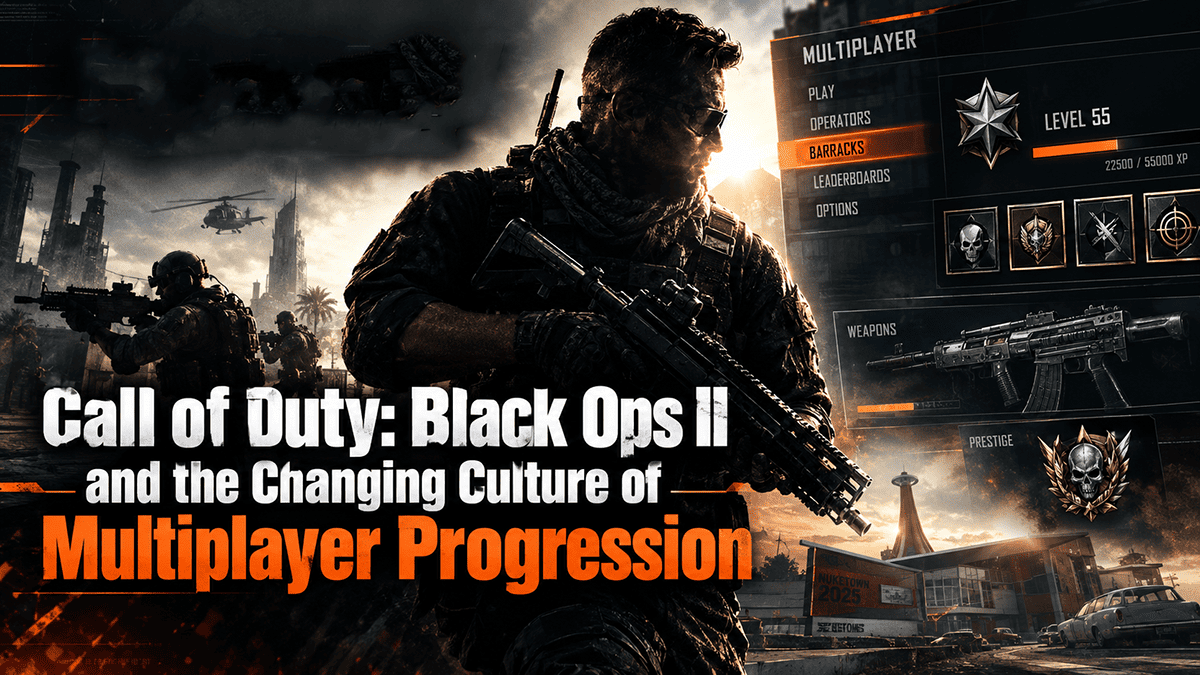
Few Call of Duty games have left as recognizable a mark on multiplayer culture as Call of Duty: Black Ops II. Released in 2012, the game arrived at a point when online shooters were becoming more than competitive matches. Progression systems, weapon unlocks, scorestreaks, customization, and social competition were becoming central parts of the experience.
More than a decade later, Black Ops II continues to attract players who remember its maps, weapons, and fast-paced multiplayer design. At the same time, the way players approach progression has changed considerably. That makes the conversation around bot lobbies, practice environments, and alternative approaches to multiplayer progression particularly interesting.
Why Black Ops II Still Matters
Black Ops II occupies a unique position in Call of Duty history.
Its multiplayer design successfully combined traditional gunplay with a more flexible class-building system. The Pick 10 system encouraged players to think carefully about what they actually needed in a loadout rather than simply equipping every available attachment and perk.
Weapons also had distinct personalities. The AN-94, MSMC, PDW-57, M8A1, and other familiar firearms created different approaches to movement, positioning, and engagement distance.
Maps such as Nuketown 2025, Raid, Standoff, and Hijacked became memorable because they supported different rhythms of combat. Some encouraged aggressive close-range encounters, while others rewarded players who understood sightlines and positioning.
That balance remains a major reason why discussions surrounding Black Ops II multiplayer have survived long after its original release.
The Changing Meaning of Progression
Modern multiplayer games have turned progression into a much larger ecosystem.
Players are no longer simply unlocking weapons. They may be working toward weapon levels, challenges, camouflage, calling cards, seasonal content, statistics, and other forms of customization.
Black Ops II came from an earlier period when progression was comparatively straightforward. You played matches, earned experience, unlocked equipment, completed challenges, and gradually developed your preferred playstyle.
For returning players, however, the grind can feel different from what they remember.
Some players enjoy earning every unlock naturally because progression is part of the entertainment. Others are more interested in experimenting with weapons, testing loadouts, or revisiting the game without spending countless hours repeating the same objectives.
That difference in priorities helps explain why alternative multiplayer environments have become a recurring topic in gaming communities.
Where Bot Lobbies Enter the Conversation
The term “bot lobby” can mean different things depending on the game and community.
At its simplest, the idea is about playing against easier or AI-controlled opponents rather than consistently facing highly experienced human players. For some players, that environment is useful for practice. It can provide a lower-pressure space to learn weapon recoil, test attachments, experiment with movement, or become familiar with maps.
For others, the appeal is connected to progression.
This is where players considering buy Call of Duty Black Ops 2 Bot Lobbies should pay attention to how such services actually operate. Not every service described as a bot lobby provides the same experience, and players should consider factors such as account security, platform compatibility, service legitimacy, and the rules governing the game or platform.
The broader point is that the demand exists because players increasingly value control over how they spend their limited gaming time.
Black Ops II as a Time Capsule of Multiplayer Design
Looking back at Black Ops II also reveals how much multiplayer design has changed.
There were no enormous seasonal ecosystems dominating every aspect of the game. The core loop was comparatively easy to understand: choose a loadout, enter a match, complete objectives, improve your skills, and unlock additional equipment.
That simplicity is part of the game’s appeal today.
Returning players often aren’t searching for another complicated live-service system. They want the familiar feeling of jumping into Raid, fighting across Hijacked, or surviving the chaos of Nuketown.
For newer players, meanwhile, Black Ops II provides an interesting snapshot of how Call of Duty multiplayer evolved before progression systems became increasingly elaborate.
Why Practice Still Has Value
Even experienced players can benefit from controlled practice.
Black Ops II has weapons with different recoil patterns, engagement ranges, and handling characteristics. Learning those details can make a significant difference when moving into more competitive matches.
A practice-oriented environment can also be useful for testing questions that are difficult to answer during normal matchmaking:
How quickly can a weapon eliminate an opponent?
Which attachments actually complement a particular playstyle?
How does a loadout perform at different ranges?
Which routes through a map are safest?
Which scorestreaks fit an aggressive or defensive approach?
These questions are ultimately about understanding the game rather than simply accumulating statistics.
The Broader Player-Economy Trend
The discussion around bot lobbies also reflects a wider trend in gaming.
Players increasingly treat their time as a resource. Some enjoy the complete progression journey, while others want to focus on specific aspects of a game. Third-party services, guides, coaching, and customization tools have emerged around that difference.
Platforms such as EZBUFF are part of this broader conversation, particularly among players looking for services connected to established multiplayer titles.
However, convenience should not replace common sense. Players should always consider whether a service complies with the relevant game’s rules and should avoid providing unnecessary account information or credentials to unknown providers.
Rediscovering Black Ops II in 2026
The most interesting thing about Black Ops II may be that its appeal has survived without needing to become something else.
Its maps remain recognizable. Its weapons still have distinctive identities. Its Pick 10 system still encourages meaningful loadout decisions. Most importantly, the game remains easy to understand while offering enough depth for experienced players to keep experimenting.
That makes Black Ops II more than a nostalgia trip.
It is a reminder of a period when multiplayer progression was closely connected to simply playing the game. Today’s players have more options than ever for how they approach that progression, including discussions around bot lobbies and alternative practice environments.
For anyone returning to Black Ops II, the real attraction is still the same: build a class, learn the map, find a weapon that fits your style, and see how far you can push your game.
The tools surrounding multiplayer may have changed, but the fundamental appeal of a well-designed Call of Duty match hasn’t disappeared.