There is something interesting happening with Madden NFL 27 in 2026. For years, the annual Madden conversation has usually followed a familiar pattern: new rosters, new ratings, a handful of gameplay improvements, another Ultimate Team cycle, and the inevitable debate over whether this year’s version is worth the upgrade.
Madden NFL 27 feels like it is trying to push that conversation somewhere else.
Released worldwide on August 13, 2026, the latest entry is less focused on simply making football look better and more interested in making the NFL itself feel less predictable. The biggest example is Franchise mode, where EA has introduced the new Persona Engine, giving players different personality types that influence motivations, negotiations, reactions and development. The result is an attempt to turn Franchise from a collection of menus and schedules into something closer to a living sports universe.
That distinction matters.
The NFL is not interesting because every team follows the same progression from Week 1 to the Super Bowl. It is interesting because things go wrong. A star wants a new contract. A rookie unexpectedly becomes a starter. A veteran starts declining earlier than expected. A coach makes a questionable decision. A locker room changes. A trade suddenly reshapes an entire division.
Madden NFL 27 is clearly leaning into that unpredictability.
Franchise Is Where Madden 27 Gets Most Interesting
The Persona Engine might sound like another feature designed for a trailer, but conceptually it addresses one of the biggest problems sports simulations have always faced: making individual players feel like individuals.
EA says Madden NFL 27 includes more than 65 different Persona DNA types. Those personalities can influence how players behave and respond to different situations, which creates the possibility of franchises developing their own internal stories rather than simply following the same statistical logic every time.
This is especially important for long-term Franchise players.
A 15-year franchise save becomes much more memorable when the league develops its own history. Maybe your quarterback refuses to accept a contract extension. Maybe a player becomes unhappy after losing playing time. Maybe a team you considered irrelevant suddenly becomes a major rival because of several successful drafts.
That is where Madden starts becoming less like a football board game and more like a sports management sandbox.
EA has also rebuilt several parts of the franchise experience around contracts, free agency, draft decisions, trade logic, coaching archetypes and weekly developments. The goal is obvious: make the decisions between games matter almost as much as what happens during the games themselves.
Interestingly, the first weeks after launch have also shown why this kind of system is difficult to get right.
EA’s August 25 Title Update specifically addressed Franchise issues involving Wear & Tear, CPU roster management, contracts and other problems. More importantly, EA acknowledged that the development team was investigating community feedback around free-agent logic, salary-cap progression, CPU decision-making, retirements and roster depth.
For me, that’s actually one of the more important stories surrounding Madden NFL 27.
A living league is a great idea, but the systems have to behave believably. If the CPU destroys its salary cap or makes obviously strange contract decisions, immersion disappears quickly. The interesting part is watching how EA tunes these systems over the coming months.
The On-Field Game Is Moving Toward Physicality
Madden has also taken a noticeable step toward making individual matchups matter more.
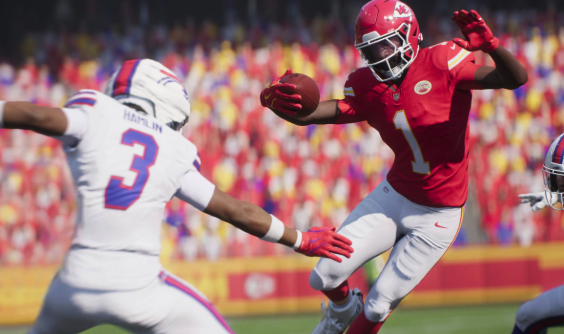
One of the headline additions is the new WR/DB interaction system. Instead of treating many receiver-versus-defender situations as relatively simple animations, Madden NFL 27 introduces more physical hand-fighting, jostling and leverage battles throughout routes. Timing-based catching also gives players more direct influence over contested catches.
That sounds like a small mechanical improvement, but it could have a bigger strategic impact.
Modern NFL football is increasingly about tiny advantages. A receiver wins half a step at the line. A corner maintains inside leverage. A quarterback recognizes a mismatch before the snap. A safety disguises coverage for another second.
Those moments are difficult to reproduce in a video game because they happen so quickly.
Madden NFL 27’s approach seems to be moving toward making those micro-battles more visible and interactive. If the system works consistently, reading matchups could become more important than simply memorizing a handful of high-percentage plays.
Dynamic weather adds another layer.
A game can begin under clear skies and develop into rain later, while field conditions can deteriorate as the game progresses. EA says these changing conditions can affect strategy, stamina, ball security and performance.
This is exactly the kind of feature that sounds cosmetic until you start thinking about how it affects play calling.
A passing-heavy offense might look completely different when conditions change. A team built around speed could have to reconsider its approach on a deteriorating field. Suddenly, weather becomes part of the game plan rather than something happening in the background.
Superstar Mode Has Become More of a Career RPG
Another major direction for Madden NFL 27 is Superstar.
This year’s G.O.A.T. Career Journey is designed to follow a player’s development from high school toward the NFL and eventually the Hall of Fame. The mode also adds deeper skill trees and new playable positions, including tight end, edge rusher and free safety. There is also integration with College Football 27’s Road to Glory progression.
This feels like another sign of where sports games are heading.
Players increasingly want more than a series of matches. They want a career arc.
They want their created player to have an identity, make choices, improve in specific ways and eventually leave behind a recognizable legacy. Madden NFL 27’s expanded progression systems are clearly designed around that idea.
It also makes the connection between college football and the NFL more interesting. Instead of treating the two games as completely separate experiences, the ecosystem is starting to feel more connected.
And Then There Is the Performance Story
One of the quieter but genuinely interesting developments in Madden NFL 27 is performance.
EA recently called it the “FASTEST MADDEN EVER,” and for once, the phrase has a fairly specific technical meaning. On PlayStation 5 Pro, Performance Pro targets 100–120 FPS during gameplay. Nintendo Switch 2 can reach 60 FPS while docked and 40 FPS in handheld Performance mode, while PC players have more granular frame-rate and display options.
For a football simulation, higher frame rates aren’t just about making screenshots prettier.
Football is a reaction game.
You are reading a linebacker, following a receiver, watching a safety rotate, looking for a running lane and trying to hit a timing window. Smoother motion can make those small decisions feel more immediate.
The Switch 2 version is particularly interesting from a broader industry perspective. Madden has traditionally been associated with living-room console gaming, but the combination of modern handheld hardware and improved performance means the audience for a full-scale football simulation is becoming more flexible. Madden NFL 27 also launched on Apple Arcade, bringing a dedicated version to iPhone, iPad, Mac and Apple TV.
That tells us something about where sports gaming is going.
The question is no longer simply, “How powerful is the console?”
It is increasingly, “Where do players want to play?”
Ultimate Team Still Has Its Own Gravity
Of course, Madden NFL 27 would not be Madden without Ultimate Team.
The mode continues to revolve around building a roster using current stars and historic players, but this year’s version introduces a revamped upgrade system, Evolutions and player-specific objectives that give users more control over how certain cards develop.
Ultimate Team will always attract a different type of player from Franchise.
Some people want to spend weeks building their perfect fantasy roster. Others prefer the slower satisfaction of developing a Franchise team over multiple seasons. Neither approach is necessarily better.
What is interesting is how Madden now effectively contains several different interpretations of football fandom inside one game.
You can be the GM.
You can be the superstar.
You can build a fantasy roster.
Or you can simply load into a game and play.
That flexibility is probably one of Madden’s biggest strengths in 2026.
The Bigger Question: Can Madden Become a Living Football Platform?
This is the part of Madden NFL 27 I find most worth watching.
The game is increasingly being designed around systems that can evolve after launch. EA’s official news feed is already showing a steady stream of updates, including the August 25 Title Update and the August 21 performance-focused Gridiron Notes.
That means the launch version is no longer the entire story.
Madden is becoming a continuously adjusted football platform.
That comes with obvious advantages, but also real risks. The more complicated the simulation becomes, the more opportunities there are for unexpected behavior. A personality system can create brilliant stories, but it can also produce strange decisions. Dynamic weather can add strategy, but only if its effects feel balanced. A deeper Franchise system is exciting, but only if the CPU can manage a believable league.
Those are the details I would pay attention to over the rest of the 2026 NFL season.
Not the marketing screenshots.
Not the overall rating debates.
The stories that emerge after players have put hundreds of hours into their saves.
Because that’s ultimately the most interesting promise of Madden NFL 27: not that every game will be perfect, but that your version of the NFL might start becoming different from everyone else’s.
And honestly, that’s a much more compelling reason to keep coming back.
If you’re the kind of player who enjoys watching a franchise develop, experimenting with different roster strategies, building a Superstar career, or simply getting lost in the weekly rhythm of the NFL season, Madden NFL 27 is probably worth keeping on your radar.
The game has already launched, the first updates are arriving, and the real test is now beginning: seeing whether all these new systems can turn a yearly football game into a league that actually feels like it belongs to you.