There is something interesting happening with sports games right now. Players are no longer looking only at gameplay mechanics, animations, or roster updates when deciding how much time they want to invest in a new title. The deeper conversation is increasingly about progression: how quickly a team can develop, how much control players have over their roster, and how the in-game economy affects the overall experience.
Madden NFL 27 sits right in the middle of that conversation.
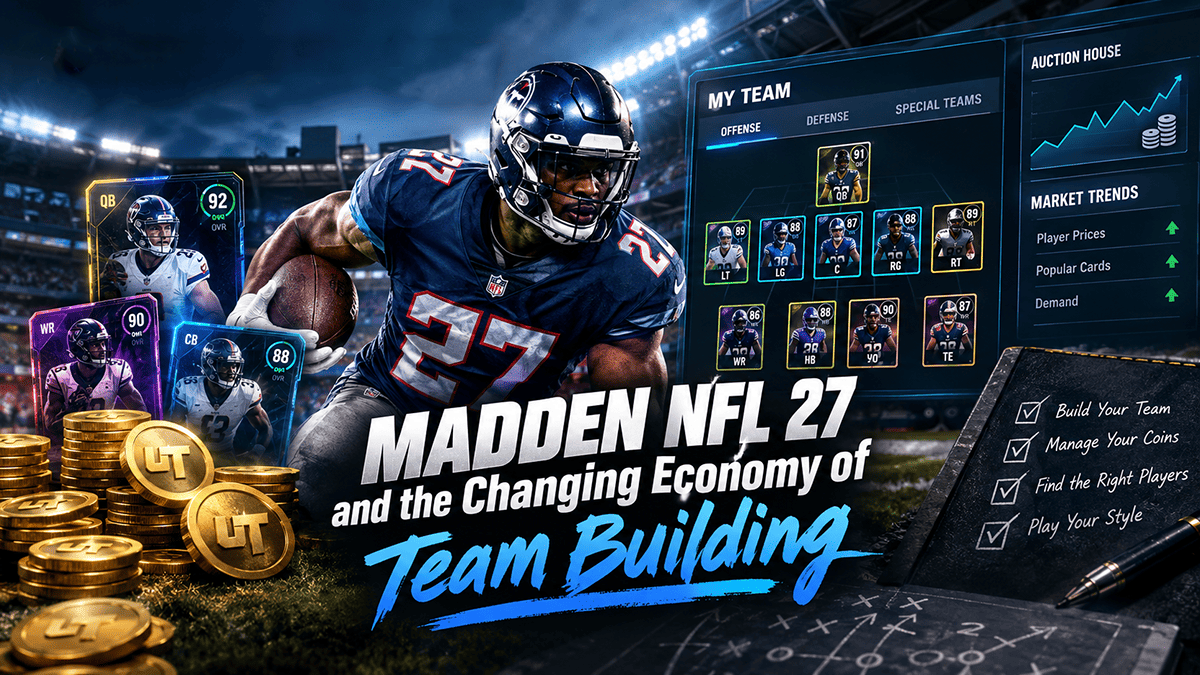
For many players, building a competitive Ultimate Team is almost a second game inside Madden. You start with an ordinary roster, identify the positions that need attention, experiment with different players and schemes, and gradually turn the team into something that reflects your preferred style of football.
The interesting part is that there is no single correct way to approach that process.
Why Team Building Has Become Such a Big Part of Madden
Football games have always been about assembling talent, but modern Madden puts considerably more emphasis on the process of improving a roster over time.
A new quarterback can change the way an offense feels. A faster receiver can open up completely different passing concepts. Upgrading the offensive line might not look as exciting on paper, but it can have a bigger impact on how consistently an offense performs.
The same is true on defense.
Adding a strong pass rusher can change how quickly an opponent has to make decisions, while upgrading the secondary can make aggressive passing strategies much harder to execute.
This creates an interesting balance between collecting players and actually understanding how those players fit together.
Having a highly rated card does not automatically create a great team. Chemistry, playbooks, abilities, formations, and user skill still matter.
That is one reason Madden NFL 27 can remain interesting long after the initial excitement of building a roster begins to fade.
Coins Are More Than Just Another Currency
For anyone spending serious time with Madden’s team-building systems, coins naturally become an important resource.
Coins can influence how quickly you can react to changes in the market, upgrade weak positions, test new players, or adjust your roster when the competitive environment changes.
Experienced players tend to look at coins differently from beginners.
Instead of immediately spending everything available, they usually think about opportunity cost.
Is a new player actually going to improve the lineup?
Is the position currently a major weakness?
Could the same amount of currency improve two or three areas instead?
Those questions become increasingly important as a team develops.
This is also why some players eventually explore options to buy Madden NFL 27 Coins. The motivation is not necessarily about skipping the entire progression system. For some players, it is simply about having more flexibility when managing a roster and spending less time waiting to accumulate enough resources for a particular upgrade.
As with any third-party purchase, players should check the relevant platform rules and understand the risks before using an external service.
The Market Creates Its Own Meta
One of the most fascinating parts of Ultimate Team is that the game has an economy alongside its football gameplay.
Player values change. New content affects demand. Popular cards can become more desirable because of a particular ability, attribute combination, or community strategy.
That means the Madden meta is not purely about what happens on the field.
It can also be about what happens before the game even starts.
A player might spend an evening comparing cards rather than playing matches. Another might monitor the market for opportunities to upgrade a position without exhausting the rest of the team’s resources.
This is where experienced players often have an advantage. They understand that roster building is not simply a race toward the highest overall rating.
Sometimes a slightly lower-rated player with the right speed, acceleration, coverage ability, or physical profile can make more sense for a particular scheme.
Build Around Your Play Style
One mistake newer Madden players often make is copying a popular lineup without considering whether it actually fits the way they play.
If you prefer short passing concepts, a quarterback with excellent deep-ball ratings may not be the most important upgrade.
If your offense relies heavily on outside runs, offensive line attributes and blocking abilities may deserve more attention.
Defensively, an aggressive user player might prioritize speed and athleticism, while someone who prefers zone coverage could build around different attributes entirely.
This is why roster building should start with your play style rather than a list of expensive cards.
Coins become much more valuable when every purchase has a clear purpose.
Spending Less Can Sometimes Mean Progressing Faster
There is also an underrated skill in Madden: knowing when not to spend.
A common temptation is to upgrade every position as soon as a new card becomes available. That approach can quickly drain resources without producing a meaningful improvement.
Instead, consider creating a priority list.
Start with the positions that are directly causing problems during games. Upgrade those first. Then reassess the roster after several matches.
For example, if your quarterback is consistently making the throws you need but your defense cannot stop opponents on third down, replacing the quarterback might have almost no practical value.
The better investment could be improving the secondary or pass rush.
This mindset turns Madden’s economy into part of the strategic game rather than simply a spending system.
Where EZBUFF Fits Into the Conversation
The growing interest in services such as EZBUFF reflects a broader trend in online sports gaming: players increasingly look for ways to manage their time alongside their progression goals.
For someone who has plenty of time to grind, earning currency through regular gameplay can be part of the fun.
For another player who has limited time because of work, school, or other commitments, spending hours on repetitive progression may feel less rewarding.
That difference in player priorities is worth recognizing.
EZBUFF is one of the names players may encounter when researching ways to obtain Madden NFL 27 resources outside the standard gameplay loop. Anyone considering such services should independently check current availability, delivery conditions, account requirements, refund policies, and the game’s rules before making a decision.
The important point is that convenience should not replace good roster management.
More currency does not automatically mean a better team.
The Real Long-Term Strategy
The most enjoyable Madden teams are usually not built in a single session.
They evolve.
A roster might begin with one offensive identity and gradually change as new players become available. A defensive scheme that worked early in the season might eventually need adjustments. A card that looked essential one week may become replaceable after new content arrives.
That constant movement is what gives Ultimate Team its long-term appeal.
The smartest approach is therefore less about chasing every new card and more about understanding why an upgrade matters.
Set priorities. Learn the market. Pay attention to your actual weaknesses. Build around your preferred style of football.
And if you decide to buy Madden NFL 27 Coins, treat the currency as a tool for roster management rather than a substitute for learning the game.
That distinction matters.
At the end of the day, the most satisfying part of Madden NFL 27 is still taking a team you have built, stepping onto the field, and seeing whether your decisions actually work when the snap happens.